So a few years ago, Max's mom discovered that you can dehydrate yogurt!! for dinner like curries and things like that. It works amazingly well. A quart of yogurt dehydrates down to about a half cup or so of powder and is the perfect complement to spicy foods, serving the important role of breaking up food monotony on the trail. It tastes a lot tangier than it does when fresh, so it's better for adding to dinners than eating straight for breakfast (at least I think). On a recent trip, I paired it with a Cashew Chicken dish that I made up and it was so good.
Cashew Chicken
Serves 2
1 small butternut squash
1 cup cashews
1 onion
4 cloves garlic, minced
1 1-inch piece of fresh ginger, peeled
1 tsp ground cloves
1 TB ground coriander
1/4 tsp ground cinnamon
1 TB cumin
2 TB coconut oil
1/2 cup coconut milk
1 cup water
3 stalks celery, diced
2 large carrots, diced
1 lb ground chicken
1/2 bag frozen peas
1/2 bag frozen spinach
juice of 1 lime
Heat oven to 350 degrees F. Cut squash in half, remove seeds, and place face down on oiled baking tray. Roast about 45 minutes, or until soft.
In a food processor, grind the onions, garlic, ginger, and cashews into a paste.
In a saute pan over medium-high heat, add the coconut oil and cashew paste. Cook for 4-5 minutes, stirring, until it turns golden brown.
Add the cinnamon, cumin, cloves, and coriander, and stir until well combined.
Stir in coconut milk and water and season with salt and pepper to taste.
In a deep pot, heat more coconut oil over medium heat. Add celery and carrots and cook for 1-2 minutes. Add ground chicken and cook until meat is cooked through, stirring and breaking up chunks often.
When squash is done roasting, let it sit until it's cool enough to handle, then scrape out the flesh. Add squash, cashew paste, frozen peas, frozen spinach, and juice of the lime to the chicken pot. Stir to combine.
Let cool about 20 minutes, then spread on dehydrator trays covered in parchment paper and dehydrate 8-12 hours at 150 F, checking several times during this process to break up clumps and turn over. More dehydrating directions found here.
Dehydrated Yogurt
Makes enough for 2 dinners for 2 people
1 quart grass-fed yogurt
Spread yogurt with the back of a spatula on parchment paper-lined dehydrator trays. Dehydrate at low temperature (or use yogurt setting if your dehydrator has one) for 6-8 hours.
Once dry, use a food processor or spice grinder to grind flakes into a powder (rehydrates better if smaller).
To rehydrate - put powder in a ziplock or bowl and just cover with water. Start with less water because you can always add more. If rehydrating in a ziplock, you can just squish the bag until it starts to rehydrate (kind of takes a while). If doing it in a bowl, use a spoon to mix well.
Thursday, August 23, 2018

Sunday, February 4, 2018
Smith Rock Climbing Trip & Skout Backcountry Review


 |
| I told you there was snow! |
Breakfast
- Eggs at home
Lunch
- Leftovers in the car
Snacks
Dinner
- Homemade Sweet Potato Chili (from our freezer) w/ lots of butter & a bag of plantain chips
- Theo 85% Dark Chocolate
Day 2
Breakfast
- Scrambled eggs & meat sticks
Lunch
- Salami, cheese, avocado, banana
Snacks
- Skout Backcountry Peruvian Chocolate Peanut Butter bar
- Skout Backcountry Spicy Texas Chili pumpkin seeds
 |
| And here comes the sun! |
Dinner
Day 3
Breakfast
Breakfast
- Scrambled eggs & meat sticks
Lunch
- Salami, cheese, avocado, banana
Snacks
Thursday, November 30, 2017
Spring Break 2017: 9-Day Menu (Car & Backpacking)

A post from last spring that I just finished up...
It’s been seven years since I’ve graduated college and I’m still not ready to give up my spring break. This time of year, when it’s been raining for about five months straight in the PNW, the dry and dust of the desert really call me. Also, Max and I conveniently still have some friends living in Salt Lake who love to adventure. We decided to meet up and do some backpacking, but they weren’t available until later in the week, so Max and I took the Nevada route from Eugene down to Utah and made a stop at Great Basin National Park. There we toured the Lehman Caves. I hadn’t been in a cave since I was little so it was a pretty cool experience. Seeing all of the elaborate stalactites, stalagmites, columns, shields, “cave bacon,” and “cave popcorn,” it was so hard to comprehend just how slowly they all grow. It was also a trip when the guide turned out the lights and the darkness was so heavy it felt like it was pushing on my eyes, and I couldn’t see my hand in front of my face. I was pretty shocked to learn that visitors in the 1800’s would throw parties deep in the caves, with music and food and dancing.

After the cave tour, we tried our hardest to get up to the Bristlecone Pine trail, but since the road to that trailhead is closed until a little later in the season, we had to start at the Upper Lehman campground, which added 3.6 miles to the trip, most of it post-holing in soft snow. We hadn’t brought snowshoes or even micro-spikes, so it was a laborious 3.6 miles. We made it to the campground but decided to turn around, since the snow had been getting unpassably deep for us without snowshoes.

My favorite part of the trail was the rose hips we found. We collected some for tea later and nibbled on the bright, sun-warmed red flesh as a little trail treat. They tasted like a fruit roll-up.


Then we headed to Ibex, Utah for some rock climbing. The first day of climbing outside after a winter of only gym climbing is always humbling. But that’s part of why I climb because the rock can really cut through your ego and teach you some real lessons. Essentially I climbed nothing beyond a V1 the first day, and even failed on some V0’s. The familiar discouragement set in, threatening to ruin the trip for me.

The first half of our trip was car camping, so we had the luxury of a cooler. Breakfasts were Soft-Boiled Eggs with Butter & Mustard, a hot dog, and a Morning Glory Muffin. Lunches were various takes on sandwich-style “Bowls” (which are really more like salads without the lettuce). On this trip we alternated between sardines or pepperoni, and added bell pepper, apple, carrot, avocado, and of course mustard. We didn’t bring enough olive oil to use some for lunch, but usually we douse it in some good extra virgin for a little extra fat. We always buy sardines packed in olive oil, so that helped a little, but the pepperoni definitely needed a little something to bring it together. Just to highlight how much we love mustard: we used an entire bottle in the first three days and ran out by Thursday breakfast. That was rough.
Sunday - Drive from Eugene, OR to Spring Valley, NV
(meals were mostly a bunch of leftovers or pre-cooked foods we brought in our cooler)
Breakfast - hard boiled eggs, avocado, yogurt & carrot radiccio salad
Lunch - grass-fed burgers, steamed carrots with olive oil, green salad
Dinner - grass-fed meat, onions, and mushrooms cooked in tallow, delicata squash, green salad
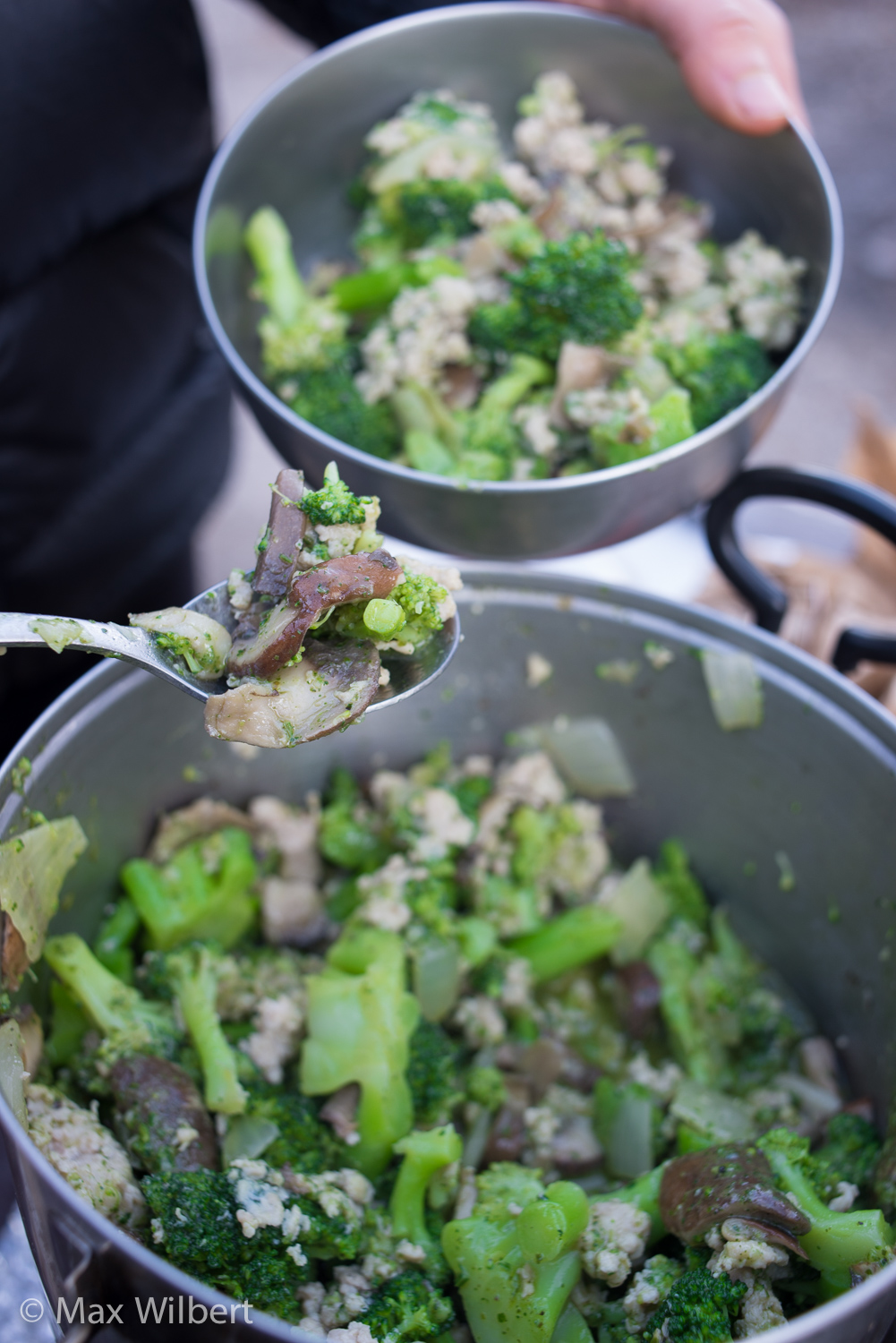 |
| Chicken Pesto Broccoli |
Breakfast - Soft-Boiled Eggs with Butter & Mustard, hot dog, Morning Glory Muffin
Lunch - Sandwich “Bowls”
Dinner - Chicken Pesto Broccoli, delicata squash (leftover from home), Theo chocolate
Tuesday - Bouldering in Ibex, UT
Breakfast & Lunch - same as above
Dinner - Salmon-Apple Bake (same as the Onion Apple Tuna Bake, but with salmon), delicata squash, carrot radicchio salad, Theo chocolate
Wednesday - A few sport climbs and some more bouldering in Ibex
Breakfast & Lunch - same as above
Dinner - Salmon Coconut Curry, Theo chocolate
Thursday - Headed to SLC to meet up with some friends and prep for the second half of our trip
Breakfast - same as above
Lunch & Dinner - city food
The second half of our trip we planned to do a little backpacking in Southern Utah. We had picked out Lower Muley Twist Canyon, but when we showed up at the ranger station to get our permit, the ranger on duty told us that they limit the number of parties in the canyons for each night, and that Lower Muley had already hit the limit of three. But she was really kind and pointed out a few other options for us, and we decided to hike Lower Spring Canyon. Because they limit the number of groups in the canyon per night, we didn’t see or hear a single person once we arrived at our campsite and we felt like we had the canyon to ourselves. We took some time to just lie and soak in the beauty of the sandstone walls, played some cards, ate some delicious food, and watched the bats swoop over our heads in our sleeping bags while we stargazed. The next day, we day-hiked Upper Spring Canyon, then returned to our campsite and moved down canyon for the night. On Sunday, we hiked Lower Spring Canyon. The ranger had told us that we would notice a difference between the upper and lower part of the canyon and she was right. The sharp, straight lines of the deep red Navajo sandstone gave way to the softer, rounder, lighter walls of the lower canyon. Since we started early enough, most of the canyon was in the shade the whole morning. At the very end we had to ford the Fremont River to get back to the road. I love any trip that ends in cold water, so I was thrilled.
Friday - Backpacking in Capitol Reef National Park: Spring Creek Canyon
Breakfast - eggs & bacon at our friends’ house before leaving
Lunch - Sandwich “Bowls”
Dinner - Cream of Mushroom Chicken Soup, chocolate
Saturday - Backpacking in Capitol Reef National Park: Spring Creek Canyon
Breakfast - Living Intentions Superfood Cereal w/ collagen & coconut milk
Lunch - Sandwich “Bowls”
Dinner - Beefy Spaghetti Squash 'n' Sauce, chocolate
Sunday - Backpacking in Capitol Reef National Park: Spring Creek Canyon
Breakfast & Lunch - same as Saturday
Dinner - Sausages, salad, sweet potatoes, wine, and chocolate back at our friends’ house in SLC
Monday - Drive from SLC to EUG
Breakfast - eggs & bacon at the house
Lunch/Snacks - sardines & oysters, carrots, apple, avocado, trail mix, plantain chips, sweet potato chips, kombucha
Tuesday, November 14, 2017
Oregon Elk Hunt & True Primal 100% GRASS-FED! Soup Review: 6-Day Menu


 Like any first time endeavor, this hunting trip surfaced more questions than answers, but it gave me a solid place to start from, on a learning journey that will take a long time. It also helped me decide that I don't want to rifle hunt; I am drawn much more to the backcountry and a bow than roads and rifles. The sound of a rifle, and hours spent at a shooting range to hone the skill is the opposite of the peace and connection I am seeking through learning to be a huntress. I know this will be exponentially more difficult than learning to rifle hunt, but I also feel like I have exponentially more to gain from it.


As far as the rest of our food goes...we were in a bit of a time crunch for preparing food, and also discovered last minute that the paleo bread we were trying to bake from Other Foods wouldn't work out because, lo and behold, we don't have a bread pan! So, we had to cut some corners and this isn't a fully paleo menu, but you can easily adapt it to be!
Food lessons from this trip:
- Bring more bars!!!! Waking up at 4am means there's a lot more of the day to be eating!
- Don't bring breakfast foods (like hard boiled eggs) that require prep at 4 in the morning! Only bring foods you can stuff in your mouth as is.
Breakfast
- 1 gluten-free blueberry muffin
- 2 Hard Boiled Eggs with Olive Oil & Mustard
Lunch
- roast beef, raw cheese, and mustard on Franz Gluten-Free Bread
- plantain chips
- apple
Snacks
- Beef & Sweet Potato Chili (cooked at home & kept in cooler)
- 1 Spiced Coconut Flour Biscuit
 |
| Homemade Beef & Sweet Potato Chili & Coconut Flour Biscuit |
Breakfast
- 1 gluten-free blueberry muffin
- 3 Knee Deep pepperoni beef sticks
Lunch
- roast beef, raw cheese, and mustard on Franz Gluten-Free Bread
- plantain chips
- apple
Snacks
 |
| Cooking up a pot of True Primal soup! |
Day 3:
Breakfast
Breakfast
- 1 gluten-free blueberry muffin
- 2 Hard Boiled Eggs with Olive Oil & Mustard
Lunch
- roast beef, raw cheese, and mustard on Franz Gluten-Free Bread
- plantain chips
- apple
Snacks
- Beef & Sweet Potato Chili (cooked at home & kept in cooler)
- 1 Spiced Coconut Flour Biscuit
Day 4:
Breakfast
Breakfast
- 1 gluten-free blueberry muffin
- 2 Hard Boiled Eggs with Olive Oil & Mustard
Lunch
- salami, raw cheese, and mustard
- plantain chips
- apple
- trail mix
Snacks
- 1 pouch True Primal 100% Grass-Fed Paleo Soup
- split a bag of Terra Chips
Day 5:
Breakfast
Breakfast
- From the Fields Gluten-Free Original Granola
- 3 Knee Deep pepperoni beef sticks
Lunch
- salami, raw cheese, and mustard
- plantain chips
- apple
- trail mix
Snacks
- 1 pouch True Primal 100% Grass-Fed Paleo Soup
- split a bag of Terra Chips
Breakfast
Lunch
- Tacos & salad at Falling Sky Brewery in Eugene!!
Monday, November 6, 2017
Cream of Mushroom Chicken Soup
I've been trying to experiment with more dehydrated meals lately and I am particularly excited about this one. It turned out really good and I packed SO many vegetables into it. I've been contemplating a lot lately how we in the civilized world have ended up eating just a few vegetables over and over again. Carrots, onions, celery. Carrots, celery, onion. Onion, celery, carrots. But there are so many other foods out there and each one offers a unique energy for your body to use. So in this meal, I tried to use a wide variety of vegetables. Ideally they would be from the wild because there is so much more energy to be drawn from wild places than from a cultivated garden or farm, but this is what I had available. I used two different types of mushrooms, onions AND leeks, cauliflower, garlic, kale, peas, and sweet potato. I think all the different ingredients also give it a much more complex flavor, something that is essential (and often lacking) in backcountry foods.
1 TB cooking fat (I think I used lard)
1 large onion, chopped
1 large head of cauliflower, chopped
2 cups crimini mushrooms, chopped
2 large white sweet potatoes, chopped
1 tsp sea salt
2 quarts chicken broth
1 TB cooking fat
1 large leek, diced
2 large portobello mushrooms, diced
3 cloves garlic, minced
1 TB dried rosemary
1 TB dried thyme
1.5 lb. ground chicken
1 bunch kale, chopped
1 bag frozen peas
In a large soup pot, heat the cooking fat over medium heat. Add onion, cauliflower, crimini mushrooms, sweet potatoes, and sea salt. Stir to coat with the cooking fat, and cook until veggies begin to get tender.
Add chicken broth to the pot, bring to a boil, then reduce to a simmer.
Simmer veggies in the broth until they are very soft.
Remove pot from heat and let cool.
Meanwhile, heat another tablespoon of cooking fat in a large soup pot over medium heat. Add leek and portobello mushrooms and sauté until veggies are tender. Add the garlic, rosemary, and thyme. Stir for about a minute to release the fragrance, then add ground chicken. Break up the chicken into small pieces with a wooden spoon and cook until chicken is cooked through.
Once broth and veggie mixture is cool, run it in small batches through the blender to puree (I like to put a towel on top of the blender and hold down to make sure splatters are kept to a minimum).
Add the blended broth mixture to the cooked leeks, mushrooms, and chicken. Bring to a boil, then reduce to a simmer and let simmer about 20 minutes.
Towards the end of the cooking time, add the kale and frozen peas. Stir to incorporate and cook until kale is wilted and peas are thawed.
Remove pot from heat and let cool.
Dehydrating & rehydrating directions found here.
Wednesday, October 11, 2017
Herbal First Aid Kit
**This is not medical advice and should not be used as such! This post is intended for educational purposes only, and if you are experiencing severe symptoms of any kind, you should immediately leave the backcountry and seek medical help. Some of this information may be useful for interim care, but should not replace professional care.**
 |
| I always carry a jar of salve for bug bites, cuts, burns, and dry lips. |
Cuts, Scrapes, and Bruises
- Herbal salve - with ingredients like comfrey, St. John's Wort, plantain, calendula, and yarrow. There are a lot of great options for buying a salve, or if you'd like to make your own, find directions here.
- Yarrow poultice - My favorite remedy to stop bleeding! I've used this multiple times on pretty deep cuts, and it's almost magical how quickly it stops bleeding. If there is fresh yarrow (Achillea millefolium) where you are, you can chew up some fresh yarrow leaf and stick it on the open wound. You can also carry yarrow tea bags (buy them or make your own), and to make a poultice, soak one in water and apply it to the wound.
Bug Bites and Stings
Plantain (Plantago major or Plantago lanceolata) is a great drawing agent, which is good for removing venom from bites and stings. It is such a powerful medicine that some people have even used it to successfully treat black widow and brown recluse spider bites, as well as snake bites.
 |
| This is Plantago major (Broadleaf Plantain). You can recognize both plantains (P. major and P. lanceolata, which are long, thin leaves) by the parallel veins of the leaves. |
- Plantain poultice - Find some plantain, chew it up until it's pulpy, and stick it on the bite or sting. Swallow whatever juices you extracted while chewing it (it's medicine on the inside and the outside!) Most effective if used immediately after bite or sting occurs.
- Plantain salve - If you're traveling in an area without plantain, you can carry a small tin of plantain salve for bites and stings.
- Plantain tincture - Taking plantain internally as well as externally can help with bites and stings, too.
Infections
- Plantain poultice - Plantain is also a great drawing agent for infections.
Burns
- Pure Aloe Vera gel - This is by far my favorite option for sunburns - plain old aloe vera gel. I buy mine from Mountain Rose Herbs. Just make sure it's as pure as you can get it. Mountain Roses's has preservatives in it, but I don't think you can get around that because truly pure aloe gel would probably spoil quickly. A lot of other products have other fillers in them, including parabens (even if they're labeled "99.9%" aloe gel).
Bug Repellent
- Bug-Off Lotion Bars by Wellness Mama
Sore or Injured Muscle and Joints
- Arnica salve
Upset Stomach
- Activated charcoal capsules - I swear by this for food poisoning-like symptoms (super gurgly stomach, diarrhea, etc.) and have also used it for acid reflux before with success. I have even seen references to it being used for giardia, although I've never had giardia so I haven't been able to experiment personally.
- Smooth Move Tea - for constipation.
- Digestive Bitters Tincture - I always take a digestive bitter before or after I eat, and it really helps my stomach feel less heavy after eating. My favorites are dandelion root or yellow dock root.
Cold and Flu
- Gypsy Cold Care Tea - This one truly makes me feel better when I'm sick.
- Throat Coat - Indispensable for sore throats.
- Usnea tincture - Usnea (Usnea barbata) or "Old Man's Beard" is another one of my favorite remedies. It is specific for respiratory and urinary issues, and is very good for sinus infections, bronchitis, strep throat, staph infections, colds, flu, pneumonia, and urinary tract or bladder infections. I make a double-extracted tincture and at the first signs of symptoms, start taking a small dose (5-10 drops) in warm water every half hour or so. Instructions to make your own here.
- Herbal cough drops - My favorite right now are Ricola's Natural Herb cough drops. They have some interesting ingredients like "color (caramel)"...what does that mean?!...and starch syrup and sugar. But even still, I love them, and they really seem to work for me. I love their herb mix they use (elder, horehound, hyssop, lemon balm, linden flowers, mallow, peppermint, sage, thyme, and wild thyme) and I'm thinking about trying to make my own, but with honey, and without the "color."
All-Purpose
So I can't verify these claims, but I recently found a website about 101 Uses for Coconut Oil, and a lot of them were first-aid related. I haven't tested any of them out, but I thought I would pass along the information, because if you're looking to go super lightweight, it would probably be handy to have just one bottle that is a cure-all. If you want to see the whole article, I linked to it above, but here are the first-aid related uses:- skin moisturizer
- SPF 4 sunscreen
- topically to speed healing of skin after injury or infection
- topically to kill yeast infections - soak a tampon in it and insert for a few hours
- topically to treat athlete's foot
- rub on inside of nose to alleviate allergies
- can help speed healing of sunburn, after initial heat is gone
- antibacterial skin cream
- reduce itchiness of mosquito bites
Wednesday, October 4, 2017
Elkhorn Crest Trail: 3-Day Menu
 |
| Twin Lakes from the Elkhorn Crest Trail |
Two of our friends got married recently and for a wedding gift, Max and I decided to plan a backpacking trip with them and make all the food. I love chances to try new recipes and especially for other people to test them! We had planned to take them to the Wild Rogue Loop in Southwest Oregon, which I've been wanting to do for a year now, but that area was smothered with smoke and also pretty close to a couple of fires. We spent several nights looking at maps of the fires and smoke, and looking at predictions for the weekend, but nothing looked clear except Eastern Oregon. We finally chose the Elkhorn Crest Trail in the Wallowa-Whitman National Forest. A little further than we wanted to drive, but it looked like our best option.
 The long drive was made a bit longer and bit more exciting because we drove right past one of the active fires burning along Highway 126. This was the first wildfire I'd seen this close and it was hauntingly beautiful. We hit the burn right as night fell, and in the growing darkness we started to see small fires here and there on the ground, looking eerily like campfires that had been abandoned, or perhaps tended by ghosts. As the line of cars crawled deeper into the heart of it, more and more firelight appeared, now on the trunks of charred trees which crackled with criss-crossed lines of glowing embers. Most of the damage had been done by now and the smoldering forest was now reminiscent of a fire pit in its last hour. A snag burned in the distance. A small stand of baby cedars crackled as they went up in flames. And then we were past it. The road wound up the hillside and we watched from above as the lights disappeared in the darkness, winking away like so many Christmas lights hung from ghosted trees.

It was amazing to see in all that destruction that many of the larger trees remained standing with green needles held high above the danger zone, and knowing that this patch of forest has a good chance of regenerating. I used to be uniformly saddened by burned forests, but after years of hiking through burned patches, have come to realize that these "damaged" areas are able to host so much life afterwards. In fact, one of the best feastings of thimbleberry I've ever had came from a previously burned patch of forest. However, when so much area burns for so long, one has to wonder...is this part of "healthy" regeneration for a forest? Or catastrophe brought on by climate change, and poor caretending of our lands? Here's an interesting article from Oregon Wild about it: 9 Things Oregonians Should Know About Forest Fires.
 |
| I think this map from 9-8-2017 speaks for itself. |
 |
| Tenkara fishing |
 |
| My first catch |


Day 1:
Breakfast - Morning Glory muffins & bacon (where we car camped) |
| Morning Glory muffins |
 |
| Cooking up the Salmon Curry |
Dinner - Easy Salmon Curry w/ collagen powder
Dessert - Key Lime Packaroons (from Heather's Choice Let's Go On An Adventure dehydrating e-book)
 |
| This was my best pot of Salmon Curry to date! |
Day 2:
Breakfast - Banana Nut & Maple Cinnamon Sprouted Buckwheat cereals (mixed together!) with coconut milk and collagenLunch - Salami Bowls, plantain chips
 |
| The salami bowls were a hit! |
 |
| Chile Verde. No that's not butter....good guess, though. It's raw cheese! |
Day 3:
Breakfast - Banana Nut & Maple Cinnamon Sprouted Buckwheat cereals (mixed together!) with coconut milk and collagenLunch - Salami slices, goat gouda cheese, more sweet potato chips, Larabars
Snacks -
- homemade beef jerky
- Sea Salt Rosemary Sprouted Almonds (also from Heather's Choice e-book)
- trail mix
- dried pineapple
- plantain chips
Subscribe to:
Posts (Atom)